
If you’re old enough, you might remember back to the days when China was inaccessible, locked away from the non-Communist world behind its Bamboo Curtain. My husband and I guessed that we would see a man walk on the moon before we saw China open its doors to the average American tourist. In 1969, Neil Armstrong proved us right.
When China finally did open up, it was an exciting time, not only for travelers, but also for businesses. My guest today, Dori Jones Yang, was there when it all happened.
In 1982, Dori, who worked for Business Week, was sent to Hong Kong as their bureau chief and sole correspondent for Hong Kong, China, Taiwan, Southeast Asia, Australia, and India. What? Yes. All of them. And she was only six years out of college. Reading the early pages of her memoir, I kept wondering: would an admittedly shy young woman be able to handle it? But Dori wanted to escape ordinariness, and she wanted to see the world. She was determined, and this was her chance.
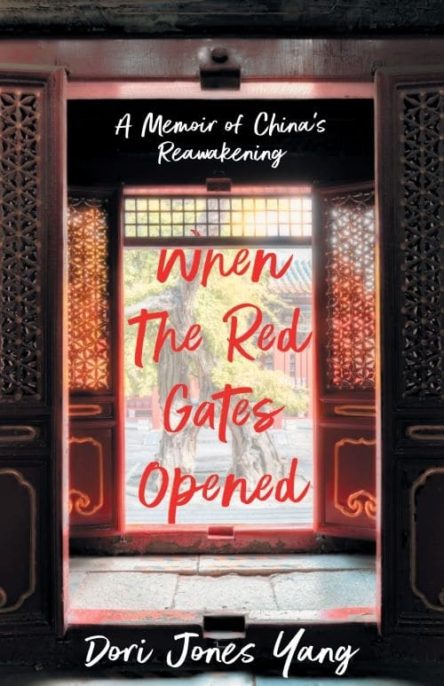
Dori’s memoir, When the Red Gates Opened: A Memoir of China’s Reawakening, was published last year, and she’s here today to tell us a little about it.
Thank you so much, Dori, for agreeing to an interview. I’m delighted to be able to introduce you and your book to my readers.
Questions:
- You’ve written eight books, from historical novels to middle-grade books, to a non-fiction book about the growth of Starbucks: Pour Your Heart into It: How Starbucks Built a Company One Cup at a Time. But this is your first memoir. People sometimes assume that a memoir would be easy to write. After all. I understand that you disagree. Why?
In my experience, writing a memoir is both more rewarding and more challenging than other types of writing. And – yes! – I’ve jumped around and written books in six different genres. (Not recommended for the faint of heart.)
Memoir challenged me to reflect deeply about my own past decisions and stretched my mind to find insights from my life (“takeaways”) that would be relevant to readers. That process was, though difficult, satisfying. Fortunately, I had my journals, my appointment calendars, my articles, and my reporter’s notebooks to refresh my memories.
But far trickier was overcoming a complete paralysis when my writing reached a painful and difficult part of my life, the time when I found out that my new love was “not quite divorced”—a state of affairs that lasted two and a half long years. That was a huge dilemma for me—but it was unrelated to the central themes of the story about a young journalist trying to understand China from the inside. I needed to write it out and digest it to learn from it, but I did not want to include any details that might hurt people I have come to love—in particular, my stepchildren. I had to abandon this part and write the rest of the book, then come back to it later. I decided to delete any information that was not directly related to my personal story and focus on the parts that were. But this balancing act wasn’t easy!
- What fear did you have to overcome during your time in Hong Kong?
I love the word “fear” because it reminds me of a question I heard years after I returned from Asia: “Weren’t you afraid?” The truth is—I wasn’t! I flew off to Hong Kong, where I had no colleagues or mentors or contacts and just ploughed ahead as best I could. This was my dream job, covering China as a foreign correspondent. I was determined to figure it out.
That said, I was an introvert, and walking into a cocktail reception where I knew no one was total agony. I would duck out early rather than approach a prominent person and strike up a conversation. An internal weakness I called “Little Me” kept asking: “Why would anyone want to talk to you, Dori?” I struggled mightily to silence that voice. Years passed before I tamed it. What it took was confidence, built on successes along the way.
- Before you left home, your mother told you, “Just don’t marry a Chinaman.” At that time, did you expect you would? Later, what were your parents’ attitudes about your marriage to Paul Yang?
I laughed when my mom said that. It never occurred to me that I would marry a Chinese man. I shook my head at both her outdated language and at her assumption that marriage was top of mind for me. Three years later, I quaked with apprehension when, home for a short visit, I approached them, separately, for tough conversations about my plans to marry Paul Yang. Mom had met him, and neither of my parents held prejudices against Chinese people, but I knew both my parents thought I should marry “my own kind.” They asked pointed questions, but in the end, they accepted Paul as their son-in-law and grew to appreciate him.

- How did you and Paul meet?
Fun story! We met on an airplane. Actually, during a fourteen-hour flight from Hong Kong to the United States, an appropriate start for an East-West love affair. Pan Am was the match-maker; its counter clerk misspelled Paul’s last name and gave him a dreaded middle seat—next to me. I thought he was attractive right away, when I heard him speak perfect Mandarin in a respectful voice to an old woman and offer to put her overstuffed bag in the overhead compartment. Our first conversation lasted nearly fourteen hours. After that, I knew I wanted to see him again. We were both living in Hong Kong, and after our return, he called me up and asked me out to dinner. Northern Chinese dumplings, shui-jiao. How could I resist?
- You were in Tiananmen Square during the protests that became a turning point in Chinese history. You spoke to protesters. When you learned about the massacre on June 4, 1989, you jumped on a plane for Beijing again and traveled around the shell-shocked city. How did your attitude toward China and your hopes for its future change that day? How has it evolved since then?
After that horrific event, I was certain that China’s progress had ended. I had spent seven years covering the hope and joy of China’s embrace of capitalism and openness to foreigners, and after June 4 I thought the whole country would take a great leap backward, ending its growth and modernization. I didn’t want to be a journalist in China anymore if it meant getting my contacts into trouble. So Paul and I left Hong Kong ten months later, returning to the United States to take different jobs.
In the thirty years since then, my predictions were proven wrong. China started growing again. Capitalists flourished and built successful corporations. US businesses thrived by selling to China and/or by sourcing products there. American consumers benefited from lower prices. Paul’s many cousins, once persecuted, were free to pursue their own dreams, inside China. They and millions of other Chinese traveled around the world and returned home to prosperity and opportunity. More than 850 million Chinese people rose out of poverty to the middle class or above. Today, most people in China are proud of their country and their progress and optimistic about the future. I am very happy for them.
Nicki, you and your husband were right: the possibility that China would open up and prosper was far from inevitable. It was as likely as a moonshot. But it happened during our lifetime, and I felt privileged to witness the early days of this transformation close up.
Thank you, Dori, for coming. I really appreciate it.
I highly recommend When the Red Gates Opened to anyone who has enjoyed this interview. I’m sure you’ll find her memoir spellbinding.
You can find out more about Dori at her website and find her book through your local bookstore or on Amazon at this link.When the Red Gates Opened is available in paperback, e-book, and audiobook, narrated by the author.


I am enticed by the interview and all that Dori has done and accomplished. AND the fact of being a multi-genre author (which I am also) and now publishing a memoir (which I am working on also). But additionally I love a good love story, and the part about how Dori and her husband met is adorable. (I’m an incurable romantic.). Thanks for a GREAT interview, Nicki. Dori, I look forward to reading your memoir.
It sounds like you and Dori have a lot in common, Pamela. I hope you’ll find her memoir as fascinating as I did.
Great interview. It must have been fascinating living there at that moment in time. I only first came here in 2006 and I feel China has changed a lot since then, so compared with the 80s it must be like night and day…
The book sounds super interesting, I’ll add it to my list!
Good. I think you’ll like it, Marta.
I visited Suzhou in the 80s, and there’s nothing I recognize from your photos. China certainlly has changed.
Terrific interview Nicki! I can see why you asked her. I will get her book.
I’m glad you liked the interview, Maureen. I hope you like the book, too.
Fascinating – and possibly timely
I’m wondering if you were referring to the trip of the rover to Mars when you said “possibly timely.”
Dori ~ you and Paul look so much alike in that photo. It was meant to be!
Nicki ~ thanks for another interesting post.
I’m glad you liked it, Nancy.
Wonderful interview. Sounds fascinating to have experienced this history. What perspective.
Yes, it absolutely must have been a fascinating experience. As she traveled around China, she interviewed all kinds of people from the highest leaders to the most common people.
I have to apologize: I forgot to add the links for purchasing her book. It’s there now.
It sounds fascinating, indeed! Thanks for sharing.
A fascinating experience during a historic time for China and the world. Also, it’s the well written story of a woman’s career challenges and romance. I loved it.
I forgot until now to add links to where its sold.
I don’t think I could ever get over the horrors of Tiananmen Square. What a rewarding and adventuress life she’s had.
My daughter graduated from college the day of the Tiananmen Square massacre (or was it the day after). To students all wore black arm band at the graduation ceremony. That’s something I’ll never forget.
This memoir sounds like it is fascinating. I’m old enough to remember the Bamboo Curtain reference. I’m glad Pan Am was able to facilitate a romance. It’s nice to think back on an airline as being helpful!
I like to think back on our many trans-Pacific flights when airline food and service were still good, even in coach. Maybe it still is on some airlines, but I’ve only traveled on domestic flights for quite a while. I have had some good conversations on those flights, though.
I couldn’t resist pointing out that you have to be old enough to fully appreciate what a big, fast change China has been through. In 1983, on my first visit to China, it must have looked much the same as it did 40 years earlier. And now, nearly another 40 years after that, there’s no comparison.
Great interview with Dori! Her memoir sounds very intriguing! You were certainly where the action took place, Dori. I taught at an English camp in Wujiang one summer, many years after you left. My team was the first group of foreigners to be in that city.
Nicki, I’d love to know how you and Dori connected.
My family visited Xiamen, China, in 1983. Although Americans had been to Beijing and Shanghai earlier, we seemed to have been the only foreigners they’d seen since maybe WWII. Even my Chinese husband, who’d been born there, was considered an outsider. His haircut was wrong, his clothes were strange, even his walk was different. But he still spoke the local dialect. So when two guys talked about him being Japanese, he gave them a piece of his mind.
Did you enjoy teaching in Wujiang?
Somehow, when I published Tiger Tail Soup, I got acquainted with another writer, Susan Blumberg Kason, who wrote Good Chinese Wife. And recently she introduced me to Dori and four other women with similar interests and backgrounds. Here’s a link to my interview of Susan:http://nickichenwrites.com/wordpress/china/1690/